
Homeschooling Weeks 1 and 2 in the books!
For anyone who's been following along as Ziqin and I have planned this adventure for our family you'll be aware that we chose to homeschool for the year we're in China! This is how weeks 1 and 2 have gone!
Long post warning, sorry!
Choosing our Schooling
For anyone who's been following along as Ziqin and I have planned this adventure for our family you'll be aware that we chose to homeschool for the year we're in China! This wasn't the original plan; originally we planned to have the kids attend local schools to give them the full China experience. However, that turned out to be kind of a logistical nightmare with all the paperwork they'd need, plus we realized the kids would likely have a bad time because of where their Chinese level is currently. They speak Chinese well enough to communicate, but not really well enough for an academic environment, so while their Chinese would surely improve, their other academics would falter.
After ruling out local schools, we considered a fully online school. However we decided that it may be both simpler and more flexible to homeschool them. So the decision was made! We figured we'd have plenty of time to plan the curriculum, so we focused on the logistics of moving to China, which we cover in this post here. We didn't really give much thought to curriculum until we actually got moved to China, then we started lots of planning with ChatGPT as our companion!
Planning the Curriculum
We don't plan to homeschool long-term, just this one school year. As such, our main goal is to make sure they're ready to re-enter the Oregon public school system in the Fall of 2027 as Fourth and Sixth graders, respectively. The main subjects to make sure they keep up with are math and Language Arts (writing, grammar, reading). We also wanted to teach history and science, and I really wanted to add in a Financial Literacy course, and Nikolai wanted me to teach him programming.
We decided we'd teach some subjects together (with perhaps different expectations from Gisele and Nikolai given they're two grades apart) and other subjects would be separate. For math I found Beast Academy which is marketed as an "honors math" for each of its grade levels (1-5) and then if you finish level 5 they have a pre-algebra curriculum students can move on to in their "Art of Problem Solving" program.
This is mostly self-paced and includes video lessons and written lessons along with interactive online problems. We started having them do it for 15 min a day while they were still technically on summer break to both get them started doing math and to make sure it was going to work for our needs before we started the school year for real. We liked it and so that's still the core of our curriculum currently! Nikolai likes math so he can advance as fast as he wants, nothing holding him back. Gisele has more a love/hate relationship with math but she's still on track to understand what she needs to well before returning to Oregon!
Next was to figure out writing, initially I decided I wanted to mainly focus Language Arts on writing and reading. Writing meaning more writing style and structure rather than specific grammar rules. We chose the IEW Structure & Style Level A video lessons series. A hiccup here was that the series relies on some physical workbooks that they couldn't ship to us out here in China (should have prepared earlier I guess!). However so far the only important things seem to be written stories which they read aloud in the videos, so I watch the videos ahead of time and type out the material. The plan is to use the videos to learn how to write and then apply that writing to assignments from other subjects (such as history and science).
Figuring out history and science took some doing. For history we settled on doing world history from the stone age to the earliest civilizations up and work our way clear up to modern times to kind of tell a high-level story of how the world got to function how it currently does! We wrote the full year's syllabus ahead of time while leaving in flexibility to make adjustments as we go. We also are keeping a parallel track to follow what's happening in China throughout the whole time period, even during times that it's not the main focus.
Science we want to both cover how science works as well as cover certain specific curriculums, and make it very hands-on with weekly experiments! This curriculum will likely have the most changes throughout the year as we don't have any particular goals for what all to cover, though we have laid out a syllabus for the year. Science gives us a little more flexibility, although we did use Oregon's grade-level science standards to make sure there weren't major gaps when they return.
Financial Literacy was a subject I threw in because I'm both passionate about personal finance and I think the kids are unlikely to get much education along those lines in the public school system! My goal is to teach the kids what money really is, why it exists, and how to use money effectively which will include things like savings, investments, tithing, charity, etc.
History, Science, Writing, and Financial Literacy are all taught to both kids at once, math they do at the same time and I float between the two of them as they have questions/need help.
Nikolai also wanted me to teach him programming, so twice a week I teach him a Computer Science course and during that time Gisele does an online art course. This is the one course I actually feel qualified to be teaching! The trick here is to break it down to teach someone clear from the beginning. I've chosen to have Nikolai start with Golang, which is not a conventional kids' first programming language, but it is a language I know well (and use professionally) and one that requires learning certain things that are abstracted away by other, more conventional starting languages (like Python or Scratch).
Gisele wanted to do an art class, so we found Artvana that Gisele works on (following the online videos) while I'm doing computer science class with Nikolai.
Of course we also wanted the kids to be concentrating on improving their Chinese, and Ziqin is leading the charge there! We decided to follow the YCT curriculum, which is designed for non-native children and teenagers learning Chinese, with set vocabulary to learn for each level. Reading Chinese is the newest thing for the kids here, they know how to speak and understand most of the 600 words covered in the 4 YCT levels already, but they've never really studied the Chinese characters.
Managing the curriculum
To manage all the curriculum I decided to build my own homeschool software platform. I had already set up a fairly involved homelab and private network for other things we needed to be able to access and manage from China. This was a natural place to host our own platform that only we need to access.
Early on we designed it just to be a place to store lessons and tasks the students needed to do, over time it has grown to include assessments, grading of assignments, experiment tracking, a library of coding challenges for Nikolai, financial-literacy tools (like an investment calculator that let's you run different scenarios and stages over time, debt calculator), math flash cards, Chinese flash cards, syllabuses, and a dashboard for us teachers to use with our planning.
I also added a custom git server to our network so that Nikolai could learn git techniques and the processes real engineers use to manage their code.


Starting School
The plan was that each day would start at 10am (I work from 5pm to 2am each day, so I needed more time to sleep). At 10am we'd first start with 45 minutes of Beast Academy math, with me floating between the kids as they need help. After that we move on to the other classes for the day, each week wanting three history classes, three science classes, two writing classes, two financial literacy classes, and then the two computer science classes for Nikolai and two art class sessions for Gisele. So each day I'd lead two to three classes. Before the first day of school I had planned out each lesson for the first week, with the plan being that each week I'd spend time preparing the following week's lessons.
Day 1
On day 1 we started with Beast Academy math, and then for writing class that day I had them do a writing assignment without giving them any guidance first. The assignment was to teach me something that they can write about without needing to do any research. They both chose Minecraft! The idea here was to get a baseline of where their writing abilities are currently, and have something to compare with later on in the year to see how we've progressed.
Next we had our first history class! In this one I introduced what we'd cover this year, below is our high-level syllabus that I presented:

Next we got into our first lesson covering the journey of hunter-gatherer -> farming -> earliest known civilization in Mesopotamia. As part of this we did an activity where I gave them a challenge! They arrive with one hundred settlers in a valley and have to survive for a year, what do they need to do? Throughout that we explored how how they'd have to collaborate to prepare to have food for the whole year, establish shelter, water, and what sorts of problems might come up. It let us discuss how things change for hunter-gatherers vs farmers, and how over time things get more complicated.
Following that we broke for lunch and then had our first science class, where again I started by covering our syllabus for the year:

A big focus this year is not just covering specific scientific subjects, but also learning how science works. So our first lesson was learning the difference between observations and inferences. Towards the end of the lesson we went outside and I had them come up with some real observations and inferences from those observations.

The final class of the day was Nikolai's first computer science class where he made his first program in Golang! Here's what his first program looked like:

And this is what it looked like when you ran it:

By the end of the first lesson he had made about four programs, and this was quickly becoming his favorite subject! While we were doing that, Gisele was making this in art class:

At the end of day one I realized just how tiring this is going to be! And after teaching all day I had only about 30 minutes before starting work.
Ziqin taught Chinese class after I was done with my classes for the day! After this we decided that she'd try and have her Chinese class with them in the morning before the 10am start time with me instead of waiting until after.

Day 2
On the second day we started with math as usual, but then we had to make our first change to the schedule! The IEW site where we needed to stream the writing videos from was down and so I couldn't stream the video. I swapped out writing class for the following day's science lesson instead! So we got to spend time building our solar oven, an activity the kids quite enjoyed! However I hadn't been fully prepared to teach this lesson that day and so when we went down to test out the oven we forgot that we needed to take measurements at regular intervals, we needed to form a hypothesis, etc, all of our scientific process was lost!


We took that as a learning opportunity though and planned to re-run the experiment later in the week! This solar oven we didn't predict would get hot enough to cook much, so we decided we'd just try to melt chocolate and marshmallows in it to make s'mores! However getting marshmallows out here is not as simple as just going to the store, so Ziqin found some online and ordered them and we figured we'd actually use them when we did a side-by-side experiment with two solar ovens the following week.
After science class we had our first financial literacy lesson where again I presented the approximate syllabus for the year:

Next we explored what money really is and why it was invented. For this we first talked about barter economies and the "double coincidence of wants" problem that arises, where a successful trade requires both people involved to want what the other has. We did some games where we had to trade, with certain scenarios engineered to require a three-way trade for everyone to get what they wanted. Then we discussed how money simplifies things and how money only has value because everyone trusts it has value. But we did discuss some pre-cursors to modern money, like how salt, shells, silver, gold, etc were used as a medium of exchange. We also discussed commodity-backed currencies (like the gold and silver standards used in the early US).
And then day 2 was over!
Day 3
By day three we were getting more into the routine. In the morning, Ziqin would do a Chinese lesson with them and then have them do 15 minutes of flash cards on their own. At 10am they both started math, calling me over when they needed help. At 10:45 we'd start the first lesson I lead of the day, this day that was our first writing video lesson. The site was working again this time! Now this lesson required a couple printed documents, we don't have a printer yet, so the night before I watched the video, typed out the documents, and then wrote these copies of them by hand:

Next up in history we covered in more detail how agriculture allowed the population to grow, allowing a smaller area of land to support more people. We discussed how this allowed people to have jobs that weren't directly involved in food production and so they could have specialties, and specialties lead to more complex societies, which would eventually lead to how the world works today. Jobs like their dad's couldn't exist without someone else producing a surplus of food, and money being invented (nice tie in to our financial literacy) to allow people to profit off of specialized skills like programming and doctors in modern society, but builders and merchants and carpenters back in early civilization.
In computer science Nikolai learned about variables and asking for user input from the terminal. He wrote a guessing game where the computer generated a random number between 1-20 and the user tried to guess it:


Day 4
This was Friday for us since day 1 was on a Tuesday this week (we chose to run school from September 1 -> May 31).
In the morning while Nikolai needed help with math I learned that I need to review certain rules of exponents! He was getting problems like these that I had to relearn how to do:


But we figured it out, and the following week we'd cover them together in more detail on the whiteboard:

On this day for writing I snuck in a review of what we'd discussed in history so far this week, having them make keyword outlines of two paragraphs that talked about the history topics, and then use their own keyword outlines to recreate those two paragraphs in their own words. After that we re-ran our solar oven experiment, this time with some chocolate inside to melt. We made sure to note the starting temperature and take the temperature every 5 minutes as we were running it. Afterwards the kids wrote up their first science reports about that experiment.


Next they took their first test! Well first non-math test. Math has built in tests throughout, so I don't have to worry about those. I'm happy to say that both kids aced the test which covered the major points of history, writing, science, and financial literacy that we had covered this week! The only point Nikolai missed was one that was a question not on Gisele's test, and also was something I forgot to cover during science class, oops!

Thus ended week one of homeschooling! Throughout the week I noted that the kids enjoyed interactive lessons a lot more so I wanted to try and figure out how to incorporate more of that into the lessons going forward, also Nikolai really wanted to spend more time coding, so I added a new coding challenges section to the school portal where he could choose to do one at any time and it would tell him what the program should do and he'd build it! He's done four or five challenges outside of regular class so far.
In addition to school they've also been engaging in various extracurricular activities including formal ping pong, badminton, and tennis lessons, and lots of informal swimming at the pool here!
Week 2
Week two was going to be a short one! Ziqin, the kids, and Ziqin's parents planned to go stay at a hotel Wednesday-Friday, so I planned the curriculum accordingly!
I won't go into quite as much detail on this week's lessons, but over the two-and-a-half days we covered writing, two history classes, computer science, art, financial literacy, science, and I had them take a grammar diagnostic on GrammarFlip to see what they need to cover in grammar this year. These were all in addition to their regular math sessions and Chinese classes with Ziqin of course. Oh and in addition to all this schoolwork they are also expected to read on their own 30 min a day.
Previously I hadn't planned on having explicit grammar classes, but after reviewing what the school district back home expected them to know going into their school years they'll be in when we return I realized we better learn that too! I found this online tool called GrammarFlip which is similar to Beast Academy, but for grammar. So they can do self-paced learning. The plan is each Friday they'll do a 30 min of GrammarFlip, and each week we also do one video writing class. Then there is a flexible language arts block that either becomes an additional writing class if the video that week has additional things they need to work on, or it becomes another GrammarFlip session otherwise.
My other change to the schedule is that we'll only have one Financial Literacy class each week instead of two! Speaking of which, the financial literacy class this week was a big hit! I gave them each $30 (of fake money) that they could purchase real items with:
- 10 minutes bonus iPad time
- Dinner from a restaurant of their choice
- candy bar
- sprite
- marshmallow
- pencil
None of the items had a price, they had to make me an offer that I could accept, reject, or counter. They could also resell items to each other, and they really got to keep the items! I needed the stakes to be high. We were exploring how price and value aren't the same thing, and how prices in the market get set. For example Gisele offered $5 for the iPad time, I rejected the offer and then she offered $15 which I accepted. Nikolai then offered $15 for the other one, but I told him since I only had one left I didn't want to let it go for the same price, so he offered $20 and I accepted. And so it went, at one point marshmallows were going for $5 a piece, but then I pulled out 10 new marshmallows, which made the price on marshmallows go down, and I sold one to Gisele for her final $2! Afterwards we talked about some instances in history when prices have gone crazy, like tulip bulbs in the Netherlands in the 1630s and beanie babies in the US in the 1990s.


Our first history lesson this week also went well! We discussed how one of the world's earliest known writing systems, cuneiform in Mesopotamia, developed, and why writing is useful in a large civilization. As part of this I had them come up with their own writing system to record simple inventories and transactions, the only rule was they couldn't use actual numbers, letters, or Chinese characters!
Nikolai made a fairly complex system where he could easily write larger numbers and track transactions. Gisele made a simpler system where she just drew pictures for each item and crossed them out if they went away. What was interesting was the pros/cons of each system. Nikolai could easily look at Gisele's records and know how much stuff there was currently without being taught how it worked, but there was no record of transactions, and for large numbers it took a long time to write since each item needed a picture! Nikolai's on the other hand could track individual transactions (5 sheep were born, 2 sheep were sold, etc), and he could write larger numbers like 54 quickly, but it was complicated. Gisele could not figure it out without being taught first.
This week we also built a new solar oven, one that was slightly smaller than the first. We discussed how when running an experiment it's important to have only the thing we want to test be different, so both solar ovens were the same materials and design, just one was slightly smaller. We wanted to see which one heated up more, we found the smaller one initially heated up faster, but the larger one hit a higher maximum temperature. This time we also made s'mores since the marshmallows had arrived! In the actual science class we discussed the different processes affecting our solar oven, such as radiation, convection, and conduction.


Summary
Overall, our first couple weeks of homeschooling have gone well! We're getting into the routine and figuring out what works and doesn't. I really like that we can cover material faster than would happen when there's one teacher with 30 students, and we can let the kids' interests guide our curriculum while still covering the material we need to! The kids can also move forward in their math and grammar classes at the pace that makes sense for them, and when we want to take a couple days off, we just do!
One thing I've learned is that the curriculum we've planned isn't going to be the curriculum we actually teach all year. We intentionally plan the individual lessons about a week ahead, and we've already made lots of changes based on what the kids actually enjoy, what they need to work on, and what's sustainable for us parents as the teachers! The syllabus we planned is intentionally high level, allowing us to forge our own path through it. That's probably the best part about it, we can take detours and change the curriculum to fit our family instead of forcing the kids to fit the curriculum!
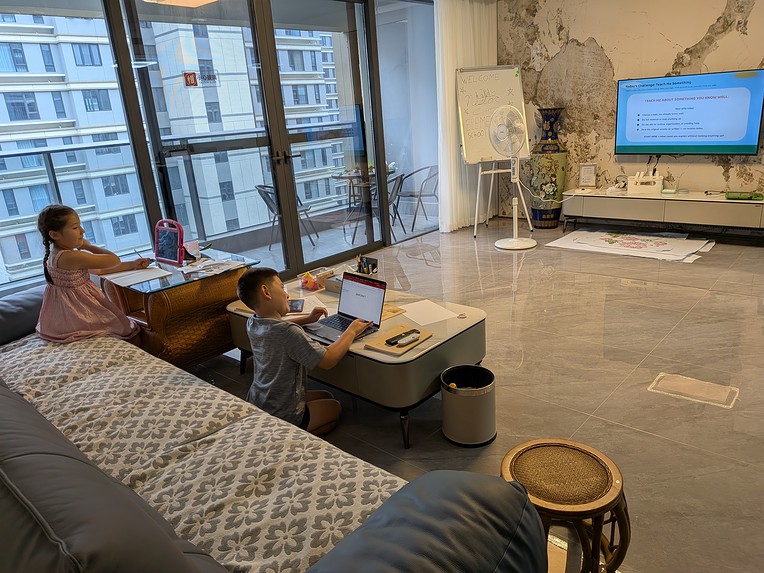
Our family room is also starting to look like a classroom:

