
The Scooter We Bought in China That We Couldn’t Legally Drive
One of the first things we realized after moving to Hainan was that we needed some kind of transportation. We don’t have a car here, and while taxis and ride-share apps are easy enough to use, they’re not ideal for every little trip around the neighborhood. A common way for people to get around here and elsewhere in China is electric scooters! So naturally, we decided to buy one.
One of the first things we realized after moving to Hainan was that we needed some kind of transportation.
We don’t have a car here, and while taxis and ride-share apps are easy enough to use, they’re not ideal for every little trip around the neighborhood. Walking everywhere also isn't great considering how hot and humid it is, it makes you need to shower way too often! A common way for people to get around here and elsewhere in China is electric scooters!
So naturally, we decided to buy one.
This seemed like it should be simple.
It was not quite as simple as we had initially thought.
The First Scooter

We went to a local scooter shop and explained what we wanted: something we could use for getting around town, taking the kids places, running errands, and generally avoiding the need to call a car every time we wanted to go somewhere a few kilometers away.
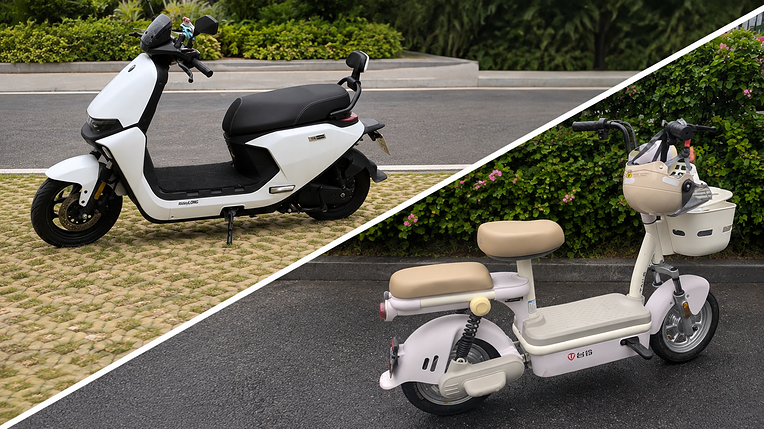
The salesperson showed us a larger electric scooter.
It looked great.
It was comfortable, had plenty of room, and could reach roughly 50 km/h.
We specifically asked whether we needed a driver’s license or anything special to use it.
We were told no.
Great.
We bought it.
I drove it home.
And then, because apparently I enjoy ruining perfectly good purchases with research, I started looking into the rules myself.
That was when things became considerably less great.
Apparently This Was Classified as a "Motorcycle"
The problem was that China makes an important distinction between different types of electric two-wheelers.
The little ones you see everywhere that top out around 25 km/h are technically considered "electric-bicycles".
The much faster scooter we had just bought did not.
At roughly 50 km/h, ours was classified more like an electric moped or motorcycle.
And that meant different rules.
Registration.
A different type of license plate.
And, most importantly for us, the appropriate motorcycle driving qualification.
Which neither of us had.
Ziqin has a Chinese driver’s license, but it’s for cars. She does not have the motorcycle qualification.
I don’t have a Chinese driver’s license at all.
So after buying the scooter, paying for it, and driving it home, we discovered that neither adult in our household could legally drive it.
Excellent.
Could I Just Get a Chinese Driver’s License?
For a little while I wondered whether there might be an easy solution.
Foreigners can, under some circumstances, use a translated foreign driver’s license to obtain a temporary Chinese driving permit without going through the entire normal licensing process.
That sounded promising.
Except my Oregon driver’s license doesn’t have a motorcycle endorsement.
So even if I successfully converted or translated my American driving privileges, that still wouldn’t magically give me permission to operate a motorcycle-class vehicle.
The problem wasn’t simply that I lacked a Chinese license.
The problem was that I lacked the motorcycle qualification in the first place.
So that idea died quickly.
Back to the Scooter Shop

Ziqin had some back-and-forth with the shop, and we ultimately decided we shouldn't risk the consequences of illegally driving the scooter. Side note: it seems to be VERY common for people here to drive those scooters without actually having the proper license.
So Ziqin drove the scooter back to the shop (which was right across the street, in fact you can see it from Nikolai's bedroom window).
To their credit, they worked with us.
We explained what we had discovered and that the scooter they had sold us wasn’t going to work for our situation.
What we actually needed was one that stayed within the electric-bicycle classification.
That meant a much lower maximum speed.
About 25 km/h.
This time we made very sure we understood what we were buying.
The replacement uses the green plate associated with the electric-bicycle category here, and it doesn’t require us to have the motorcycle qualification that the faster scooter would have required.
So we exchanged the first scooter for the slower one.
Problem solved.
Mostly.

Going From 50 km/h to 25 km/h
I will admit that going from a scooter capable of around 50 km/h to one capped at roughly 25 km/h felt a little disappointing at first.
The first one felt like an actual vehicle.
The replacement feels considerably more like an electric bicycle wearing a scooter costume.
But after using it for a while, 25 km/h is actually plenty for what we need.
Most of our trips are short.
We’re riding around residential areas, going to stores, and making little trips around this part of Hainan.
We’re not trying to commute down a freeway.
And given the traffic patterns here, there are probably worse things than being physically prevented from going particularly fast.
I even managed to ride it 5 miles away to the nearest hiking area.
The Price Was Hard to Complain About
The funniest part may be how inexpensive the whole thing was compared with what I would expect to pay in the United States.
Our final scooter cost roughly the equivalent of $355 USD brand new.
And this isn’t some tiny one-person stand-up scooter.
There’s enough room that I can take both kids with me, or Ziqin and I can ride together.
For a family that doesn’t own a car here, it has already become incredibly useful.
Need to run to the store?
Scooter.
Need to grab food somewhere nearby?
Scooter.
It’s quickly becoming one of those things that makes living here feel much easier.
We now have a legal scooter, a green license plate, and it doesn't go faster than 25 km/h, but that's still a lot faster than I can walk!